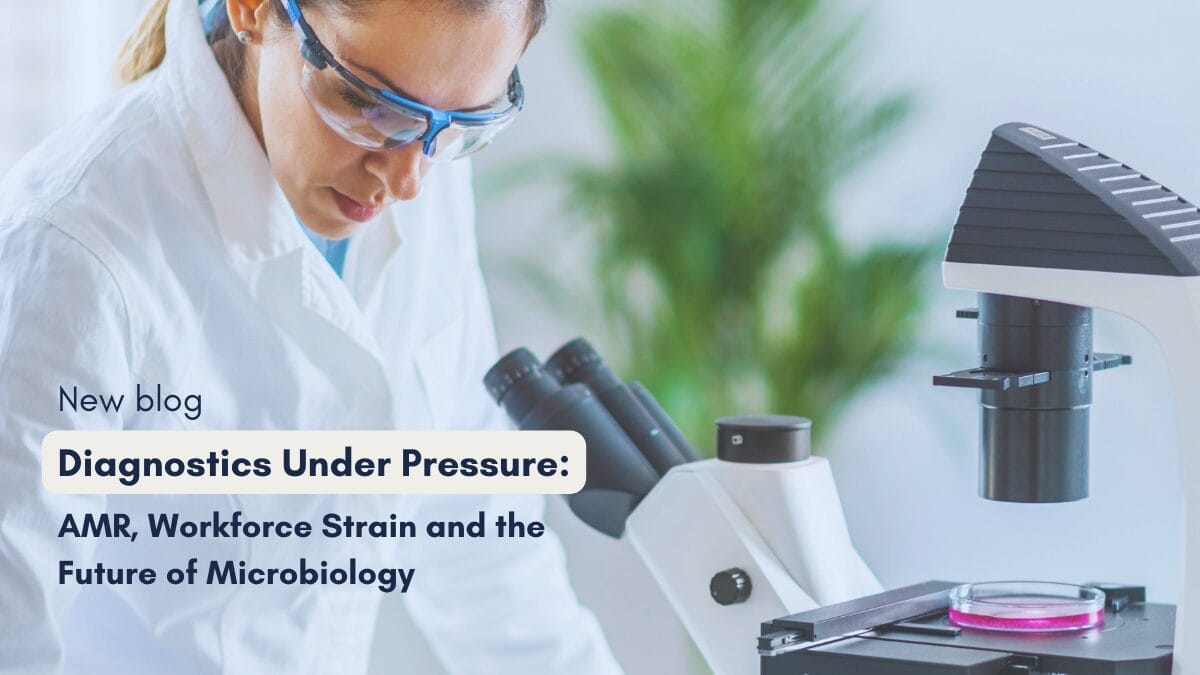
Diagnostics Under Pressure: AMR, Workforce Strain and the Future of Microbiology
Microbiology laboratories are operating at a critical intersection.
Antimicrobial resistance (AMR) continues to increase the complexity and urgency of diagnostic decision-making, while workforce shortages are reducing operational capacity across pathology services. As national guidance reinforces AMR as a strategic priority, laboratories are being asked to deliver faster, more precise results — often with fewer staff and tighter resources.
This is not a temporary pressure. It represents a structural shift in how microbiology services must operate.
AMR is Raising the Stakes for Diagnostic Performance
Antimicrobial resistance is no longer a distant public health concern – it is shaping day-to-day laboratory demand. Rising rates of resistant organisms, including carbapenemase-producing pathogens, are increasing the need for rapid detection and accurate differentiation to support infection prevention and control.
Timely, reliable diagnostics now directly influence:
- Antimicrobial stewardship decisions
- Isolation and IPC protocols
- Length of hospital stay
- Overall patient outcomes
As NHS England highlights AMR as a strategic priority, the expectation placed on microbiology laboratories is clear: results must be accurate, reproducible and delivered quickly enough to guide clinical action.
Efficiency is no longer simply operational – it is clinical.
For more details on these strategies, you can read the full NHS England AMR Overview here.
Workforce Pressures Are Limiting Capacity
At the same time, biomedical science teams are facing sustained workforce strain. Reports from the Institute of Biomedical Science continue to highlight recruitment challenges, increasing workloads, and the impact of staffing shortages on morale and service delivery.
For many laboratories, this means:
- Greater reliance on experienced staff
- Increased risk of burnout
- Reduced flexibility in responding to peaks in demand
- Pressure on turnaround times
When workforce capacity tightens while diagnostic complexity increases, laboratories must find new ways to protect both performance and staff wellbeing.
The IBMS Workforce Perspective emphasises the need for a well-planned workforce strategy to address these challenges effectively. To learn more, check out the IBMS submission here.
Efficiency Now Equals Resilience
Improving diagnostic efficiency is no longer about incremental productivity gains. It is about service resilience.
Laboratories that invest in smarter workflows, clearer result interpretation and reduced manual burden are better positioned to manage rising demand without overextending their teams.
Technology and process optimisation can support this shift by:
- Reducing repetitive manual steps
- Improving standardisation across users and shifts
- Supporting reproducibility and auditability
- Enhancing integration with laboratory information systems
Automation and digital solutions are not replacements for expertise – they are tools that allow highly skilled professionals to focus on complex diagnostic decision-making rather than routine tasks.
Supporting Staff is Central to Sustainable Services
Addressing workforce challenges requires a combination of workforce support, process improvement, and strategic investment.
Supporting Staff Wellbeing and Retention
Addressing workforce challenges requires more than recruitment alone. Sustainable pathology services depend on:
- Ongoing professional development
- Clear and streamlined workflows
- Technologies that reduce subjectivity and manual interpretation
- Organisational support for wellbeing and retention
When diagnostic pathways are well designed and supported by appropriate tools, staff confidence improves, errors are reduced, and job satisfaction increases.
Efficiency and workforce sustainability are not competing priorities – they are interdependent.
A Strategic Moment for Microbiology
The combined pressures of AMR and workforce shortages present a defining moment for microbiology services.
Laboratories that take a proactive approach – reviewing diagnostic pathways, evaluating workflow efficiency and investing in solutions that genuinely reduce operational burden – will be better placed to maintain service quality in the years ahead.
As diagnostic demand continues to evolve, the question is no longer whether change is needed, but how laboratories can adapt in ways that strengthen both clinical performance and team resilience.
Improving efficiency, supporting staff and enhancing diagnostic clarity are not short-term fixes. They are essential steps toward ensuring sustainable, high-quality microbiology services in an increasingly complex healthcare landscape.
Further reading:
NHS England, Antimicrobial resistance (AMR): https://www.england.nhs.uk/ourwork/prevention/antimicrobial-resistance-amr/
Institute of Biomedical Science, IBMS informs NHS 10-year workforce plan: https://www.ibms.org/resource/ibms-informs-nhs-10-year-workforce-plan.html