

From Policy to Practice: What the UKHSA Syphilis Response Means for POCT Services
Introduction: A Renewed National Focus on Syphilis
The UK Health Security Agency (UKHSA) continues to build on the national Syphilis Action Plan first published in 2019, with renewed urgency driven by sustained increases in diagnoses across England.1,2
This is not simply a policy update. It reflects a wider shift in how sexual health services are expected to operate — with faster access to testing, earlier diagnosis, and care delivered closer to the patient.
For Point-of-Care Testing (POCT), this signals a clear evolution in service design. Diagnostics are no longer confined to laboratories or specialist clinics; they are becoming embedded across entire care pathways.
Why This Matters for POCT Services
The current national focus highlights several priorities that directly impact testing pathways:
- Earlier diagnosis through improved access
- Expansion of services into community and outreach settings
- Faster treatment initiation to reduce onward transmission
- Improved engagement with high-risk and underserved populations
These priorities align with national public health strategy and clinical guidance for STI management1,3.
At the same time, guidance from British Association for Sexual Health and HIV (BASHH) continues to reinforce expectations around timely diagnosis, access, and patient management3.
Together, these drivers are accelerating the move towards more decentralised, responsive diagnostic models — placing POCT at the centre of delivery.
Enabling Faster Decisions: The Role of Rapid Testing
Rapid point-of-care testing is expected to play a key role in supporting these national objectives.
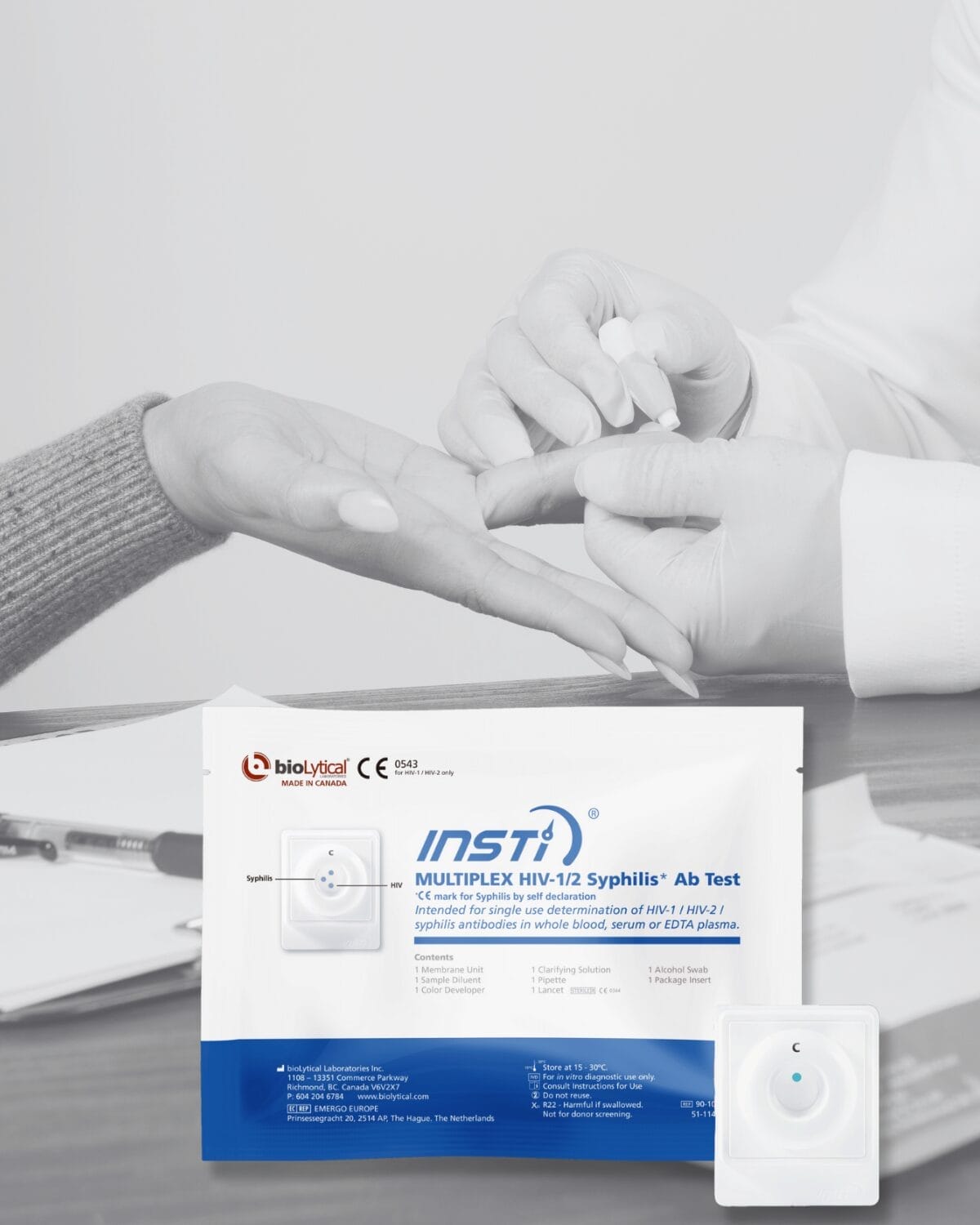
Technologies such as INSTI® rapid HIV and syphilis tests enable results to be delivered within minutes, fundamentally changing how and where care can be provided. This supports:
- Same-visit clinical decision-making
- Improved patient engagement, particularly in outreach and non-clinical settings
- Reduced reliance on laboratory turnaround times
- Faster initiation of treatment where required
This capability is particularly valuable in settings where immediate results can influence patient pathways — helping services reduce delays, minimise loss to follow-up, and improve overall outcomes4.
Expanding Access Beyond Traditional Settings
The implications of this shift are significant. Testing is increasingly being delivered across:
- Community-based services
- Mobile and outreach clinics
- Primary care and urgent treatment centres
- Non-specialist clinical environments
This expansion improves accessibility, but it also introduces complexity.
Unlike controlled laboratory environments, these settings often involve:
- Non-laboratory staff performing tests
- Variable levels of training and competency
- Limited on-site quality infrastructure
- Fragmented or evolving IT systems
As a result, the responsibility placed on POCT teams continues to grow, particularly in maintaining safe and standardised diagnostic practice4.
Governance: The Critical Enabler
As POCT becomes more widely distributed, governance is no longer a background consideration — it is central to safe and effective service delivery.
POCT leads must ensure that testing remains:
- Clinically appropriate
- Operationally sustainable
- Standardised across multiple locations
- Fully compliant with quality and regulatory frameworks
This aligns with broader expectations across the National Health Service (NHS), where diagnostic services must meet stringent standards for quality, traceability, and patient safety4.
Key governance considerations include:
- Training and Competency – Ensuring all operators — particularly non-laboratory staff — are appropriately trained, assessed, and supported.
- Quality Assurance – Maintaining robust internal quality control and participation in external quality assessment (EQA), even in decentralised environments.
- Connectivity and Data Capture – Ensuring results are accurately recorded, traceable, and integrated into clinical systems.
- Cross-Service Oversight – Managing pathways that span multiple services, organisations, and clinical teams.
The Opportunity: Smarter, Integrated Pathways
Despite the challenges, the expansion of POCT presents a significant opportunity to improve sexual health pathways.
Approaches such as multiplex testing, which allow simultaneous screening for HIV and syphilis, can support:
- Streamlined patient journeys
- Reduced duplication of testing
- More efficient use of clinical time and resources
- Improved patient experience
When implemented effectively, these innovations enable services to move towards more integrated, patient-centred models of care3,4.
Key Consideration for POCT
How will rapid STI testing be governed across non-traditional settings?
This remains the defining question.
Without robust governance frameworks, the benefits of rapid testing — speed, accessibility, and efficiency — risk being undermined by variability and lack of oversight.
From Policy to Practice: The Evolving Role of POCT
The renewed UKHSA focus on syphilis reflects a broader trend across healthcare: diagnostics are moving closer to the patient, and services are being redesigned around access, speed, and outcomes2,4.
For POCT leads, this means an expanded role that goes beyond implementation, including:
- Supporting pathway redesign
- Enabling safe adoption of new technologies
- Providing governance across complex service models
- Ensuring long-term sustainability
At Una Health, we work closely with POCT teams, pathology networks, and clinical services to support this transition — ensuring that innovation delivers both clinical value and robust governance.
Final Thoughts
The direction of travel is clear. Sexual health diagnostics are becoming faster, more accessible, and more widely distributed across care settings.
The UKHSA’s continued focus on syphilis highlights both the urgency and the opportunity.
For POCT services, the question is no longer whether to adopt rapid testing — but how to implement it safely, consistently, and at scale.
References
- UK Health Security Agency (2019) – Syphilis Action Plan – https://www.gov.uk/government/publications/syphilis-public-health-england-action-plan
- UK Health Security Agency (2024–2025) – Sexually transmitted infections (STIs): annual data tables and surveillance reports – https://www.gov.uk/government/collections/sexually-transmitted-infections-stis-annual-data-tables
- British Association for Sexual Health and HIV (BASHH) – UK National Guidelines for the Management of Syphilis – https://www.bashhguidelines.org/current-guidelines/sti-management/syphilis/
- National Health Service – Diagnostics and point-of-care testing guidance – https://www.england.nhs.uk/diagnostics/