
Laboratory perspectives on midstream urine
Why sample quality is becoming a defining issue for diagnostic stewardship, laboratory efficiency, and antimicrobial resistance in the NHS
Introduction: from routine test to system pressure point
Midstream urine (MSU) sampling is often viewed as one of the most routine elements of diagnostic medicine. Yet at scale, it represents one of the largest and least optimised pathways in UK diagnostics.
With an estimated ~65 million urine samples processed annually¹, even small inefficiencies are amplified across the system. Contamination rates of **20-30%**¹,² are not just a technical inconvenience, they represent a structural inefficiency embedded within the diagnostic pathway.
For microbiology and pathology professionals, this raises an important question:
At what point does a “routine issue” become a strategic priority?
The answer is increasingly clear. Poor urine sample quality is no longer just a pre-analytical problem, it is a driver of laboratory demand, diagnostic uncertainty, and antimicrobial risk.
The reality of midstream urine collection
Midstream urine remains the recommended standard across UK guidance, including NHS and NICE pathways. However, its effectiveness in practice is constrained by how samples are actually collected.
In real-world settings, urine collection:
- Takes place outside controlled clinical environments
- Relies on patient understanding of instructions
- Depends on correct execution of the “midstream” technique
In reality, the current method relies heavily on patient technique in uncontrolled environments.
For many patient groups – including women, older adults, and those in acute or primary care settings – this introduces significant variability. As a result, samples labelled as “midstream” are often not truly midstream in physiological terms.
This helps explain a persistent paradox in microbiology:
- Clear guidance exists
- Education is widespread
- Yet contamination rates remain consistently high
This is not simply a training issue – it is a system reliability issue.
Reframing the problem: MSU as a diagnostic stewardship challenge
The traditional framing of urine contamination focuses on technique: patient instruction, collection method, or labelling errors. While these remain relevant, they do not fully capture the scale or implications of the issue.
A more useful lens is diagnostic stewardship.
When MSU quality is poor:
- Laboratories generate ambiguous or non-actionable results
- Clinicians are forced into repeat testing or empirical decisions
- Antibiotic prescribing may occur before diagnostic clarity is achieved
The NIHR has explicitly linked traditional urine collection practices to antimicrobial resistance (AMR), noting that unreliable specimens can contribute to early broad-spectrum prescribing².
This is particularly significant given:
- Evidence data points to 92% of UTI bacteria already resistant to at least one common antibiotic and 80% of UTI bacteria already resistant to at least two common antibiotics.
- Up to 47% of Gram-negative bloodstream infections originate from urinary sources²
- Urinary infections are a major contributor to global AMR trends²
- 20-25% of Sepsis cases have a urinary source, largely caused by poor prescribing practice at point of care where broad spectrum antibiotics are given without culture

From this perspective, MSU contamination is not just inefficiency – it is a signal of diagnostic system weakness.
The hidden operational burden on laboratories
Laboratories experience the impact of poor sample quality first-hand, but the true cost is often underestimated.
At a system level, contamination drives:
- Repeat cultures and duplicate workload
- Extended turnaround times
- Increased administrative and reporting complexity
- Reduced confidence in microbiological interpretation
Financially, even conservative modelling suggests a substantial burden. With millions of repeat samples annually, avoidable costs to the NHS are estimated in the tens to hundreds of millions of pounds per year¹.
However, the more important cost is opportunity cost:
- Time spent managing avoidable repeats
- Capacity diverted from complex diagnostics
- Reduced ability to innovate or improve services
This is where MSU quality becomes a laboratory performance issue, not just a sample issue.
Evidence of change: small interventions, system-wide impact
One of the most compelling aspects of the MSU pathway is how relatively small upstream interventions can produce disproportionate downstream gains.
A UK quality improvement study at Leeds Teaching Hospitals NHS Trust demonstrated that:
- Rejected MSU samples fell from 17% to 5%, then to 0% following improvements in electronic requesting³
This finding is often interpreted narrowly as a success in request quality. But its broader implication is more important:
Laboratory outcomes are highly sensitive to upstream process design.
This principle applies equally to:
- Collection technique
- Request completeness
- Clinical decision-making at the point of testing
In other words, laboratories are not just endpoints—they are integrators of pathway quality.
A system under pressure: primary care, prescribing, and uncertainty
The challenge is compounded by patterns in primary care.
Recent UK evidence shows:
- 50.8% of UTI episodes involve urine testing
- 78.2% result in same-day antibiotic prescribing⁴
This reflects a system operating under:
- Time pressure
- Diagnostic uncertainty
- Risk-averse decision-making
In this context, sample quality becomes critical. A contaminated or ambiguous result does not simply delay diagnosis—it can reinforce empirical treatment pathways, undermining antimicrobial stewardship goals.
This is why NICE guidance continues to emphasise appropriate testing and interpretation of urine samples⁵. However, guidance alone cannot resolve variability in real-world collection practices.
The strategic role of laboratories: from observers to influencers

Traditionally, laboratories have been positioned as passive recipients of samples. That model is no longer sustainable.
High-performing diagnostic services are increasingly characterised by laboratories that:
- Actively monitor and interpret pathway performance
- Feed back data into clinical systems
- Influence upstream behaviours
In the context of MSU, this means moving from:
Measuring performance → Shaping pathways
Reporting contamination → Understanding its drivers
Highlighting issues → Enabling solutions
What leadership looks like in practice
Laboratory-led improvement in MSU quality does not require large-scale transformation. It requires targeted, consistent interventions aligned with system priorities.
1. Feed back on contamination rates
Labs see the problem first-hand – but often the data isn’t fed back.
- Track contamination and mixed growth rates by ward / service
- Share simple monthly dashboards with clinical teams
- Highlight impact (repeats, delays, cost)
Shift the conversation from anecdotal to evidence-based.
2. Standardise collection guidance
Variation in how samples are collected is a major cause of contamination. Labs can:
- Provide clear, standardised instructions for urine collection
- Work with primary care and POC teams to embed best practice
- Support inclusion in local SOPs and pathways
Consistency = fewer errors.
3. Influence upstream behaviour
Labs are not just passive recipients – they can shape pathways.
- Engage with infection teams, ED, maternity, primary care
- Provide guidance on when a urine sample is actually needed
- Support diagnostic stewardship
Reduces unnecessary samples and improves quality.
4. Promote better collection methods
Traditional midstream collection is still highly variable. Labs can:
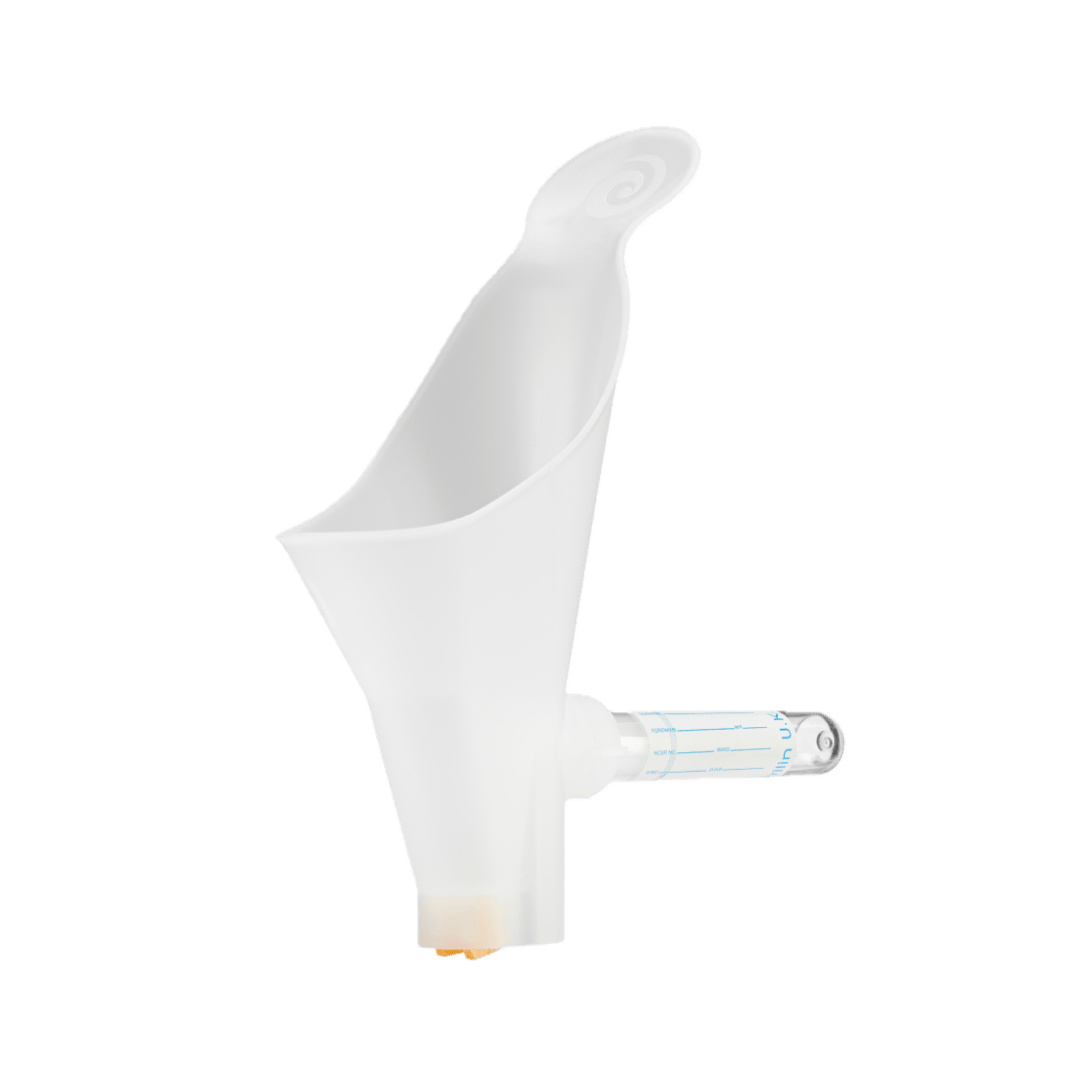
- Evaluate alternative collection devices (e.g. Peezy Midstream-type solutions)
- Share evidence when contamination has been reduced
- Support pilot studies or evaluations
This is one of the highest-impact changes you could do.
5. Improve requesting quality
It’s not just the sample. It’s the information that comes with it.
As shown in NHS quality improvement work, incomplete requests can lead to:
- Rejection rates of ~17%⁴
- Delays of 1–4 days for repeat samples⁴
Labs can:
- Push for electronic requesting systems
- Reinforce required clinical details
- Reduce rejection and rework
6. Close the loop with clinicians
Often, clinicians don’t realise the downstream impact of poor samples. Labs can:
- Share examples of mixed growth / contamination impact
- Link sample quality to antibiotic prescribing decisions
- Support education sessions
This builds understanding – not blame.
7. Align with NHS priorities
Better sample quality supports:
- AMR reduction (by reducing unnecessary antibiotics)
- Efficiency savings (fewer recollection and re-cultured samples)
- Workforce sustainability
- Streamlined patient pathways
This makes it easier to get buy-in at management level.
A shift in mindset: from sample quality to system quality
The most important shift is conceptual.
Midstream urine contamination should not be viewed as:
- A patient compliance issue
- A training gap
- A minor operational inconvenience
It should be recognised as:
A system-level quality indicator that reflects how well the diagnostic pathway is functioning.
Laboratories are uniquely positioned to see this clearly:
- They observe variation across services
- They quantify its impact
- They understand downstream consequences
This positions microbiology teams not just as diagnostic providers, but as leaders in pathway optimisation.
Conclusion: a high-impact opportunity hiding in plain sight
In a healthcare system under sustained pressure, the most valuable improvements are often those that:
- Are scalable
- Are evidence-based
- Deliver both clinical and operational benefit
Improving MSU sample quality meets all three criteria.
It offers:
- Reduced laboratory burden
- Improved diagnostic confidence
- Better antimicrobial stewardship
- Faster, more reliable patient pathways
Most importantly, it represents an area where laboratory leadership can directly influence system performance.
The question is no longer whether urine sample quality matters – but how actively laboratories choose to lead on it.
References
- UK diagnostics estimates and sector data on urine sampling volumes and contamination
- National Institute for Health and Care Research (NIHR) (2024). How traditional urine collection methods are fuelling AMR
- Jakes A., McCue E., Cracknell A. (2014). Improving midstream urine sampling: reducing labelling error and laboratory rejection. BMJ Quality Improvement Reports
- Butler CC et al. (2024). Urine testing and antibiotic prescribing for suspected UTI in English primary care: population-based study
- NICE (2018, updated). NG109: Urinary tract infection (lower): antimicrobial prescribing